
Research Areas
Anomalous Experiences and SoC
With respect to Anomalous Experiences (unusual but not necessarily pathological experiences) these are among my most influential works:
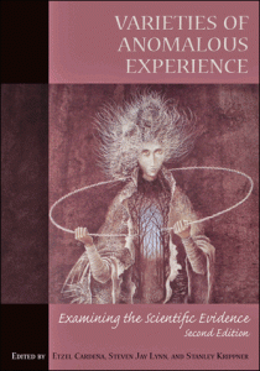
Publishing in a major press award-winning coherent psychological summaries and integration of such experiences, differentiating them from pathology (e.g., Cardeña et al., 2000, 2014, 2017). I have also published specific papers on specific experiences such as near-death and mystical experiences, automatic writing, and identity alteration (e.g., Cardeña & Alvarado, 2014; Lindström et al., 2023; Melloul Ait et al. 2024
In the closely related topic of States of Consciousness, I can mention a two-volume multidisciplinary anthology (Cardeña & Winkelman, 2011a,b) illustrating the centrality of alterations of consciousness in various areas including clinical psychology, sociology, religion, philosophy, and many others.
Along with Steven Jay Lynn, I co-edited an invited journal section and wrote a related paper sumarizing various functions of alternate states (Cardeña, 2020; Cardeña & Lynn, 2020) . More recently I have spearheaded the development of a consensus taxonomy of alternate states of consciousness (Cardeña et al., 2025), which I am evaluating empirically with a doctoral student (a supplementary ongoing project is the creation of a dimensional taxonomy of states of consciousness). Another ongoing interest is evaluating whether how different inductions affect -if at - the ensuing neurophenomenological responses (Cardeña et al., 2026).
Selected References (for others see my CV)
Cardeña, E. (2020). Derangement of the senses or alternate epistemological pathways? Altered consciousness and enhanced functioning. Psychology of Consciousness: Theory, Research, and Practice, 7(2), 242-261. dx.doi.org/10.1037/cns0000175
Cardeña, E., Berkovich-Ohana, A., Valli, K., Bartfeld, P., Gómez-Marín, A., Greyson, B., Kumar, V. K., Laureys, S., Luhrman, T. M., Newberg, A., Preller, K. H., Putnam, F. W., Tagliazucchi, E., Walsh, R., Carter, O., & Yaden, D. (2025). Bringing order to multiplicity: A consensus taxonomy of non-ordinary states of consciousness. Psychology of Consciousness: Theory, Research, and Practice. Advance online publication. https://doi.org/10.1037/cns0000431
Cardeña, E., & Alvarado, C. (2014). Anomalous self and identity experiences. In E. Cardeña, S. J., Lynn, & S. Krippner (Eds.), Varieties of anomalous experience: Examining the scientific evidence. 2nd ed. (pp. 175-212). Washington, DC: American Psychological Association.
Cardeña, E. & Lindström, L. (2021). The light and the bulb: The psychology and neurophysiology of mystical experience. In A. Moreira-Almeida, B. Paz Mosqueiro, & D. Bhugra (Eds.), Spirituality and mental health across cultures, 95-113. Oxford University Press.
Cardeña, E., & Lynn, S. J. (Eds.) (2020). Special section: Altered states and enhanced functioning. Psychology of Consciousness: Theory, Research, and Practice, 7(3), 238-329.
Cardeña, E., Lynn, S. J., & Krippner, S. (Eds.). (2000). Varieties of anomalous experience: Examining the scientific evidence. American Psychological Association. Doi: 10.1037/14258-000
Cardeña, E., Lynn, S. J., & Jamieson, G. (2026). A neurophenomenological study of ganzfeld and hypnosis: Part 1, phenomenology. Psychology of Consciousness: Theory, Research, and Practice. Advance online publication. https://doi.org/10.1037/cns0000476
Cardeña, E., Lynn, S. J., & Krippner, S. (Eds.) (2014). Varieties of anomalous experience: Examining the scientific evidence (2nd ed.). Washington, DC: American Psychological Association. Doi: 10.1037/14258-000
Cardeña, E., Lynn, S. J., & Krippner, S. (2017). The psychology of anomalous experience: A rediscovery. Psychology of Consciousness: Theory, Research, and Practice, 4, 4-22. http://dx.doi.org/10.1037/cns0000093
Cardeña, E., & Winkelman, M. (Eds.) (2011a). Altering consciousness. Multidisciplinary perspectives. Volume I. History, culture, and the humanities. Praeger.
Cardeña, E., & Winkelman, M. (Eds.) (2011b). Altering consciousness. Multidisciplinary perspectives. Volume II. Biological and psychological perspectives. Praeger.
Lindström, L., Goldin, P., Mårtensson, J., & Cardeña, E. (2023). Nonlinear brain correlates of trait self-boundarylessness. Neuroscience of Consciousness. Published online, doi: 10.1093/nc/niad006
Melloul Ait, A., Kinnunen, K., & Cardeña, E. (2024). The phenomenology of distressing near-death experiences and their aftereffects. Journal of Anomalous Experience and Cognition, 4(2), 192-224. https://doi.org/10.31156/jaex.25433
DISSOCIATION AND TRAUMA
Dissociation is a topic closely related to hypnosis. Some of my main areas of interest are:
- The clarification of the domain (Cardeña, 1994), processes (Cardeña & Marcusson-Clavertz, 2016) and a definition of pathological forms of dissociation (Cardeña & Carlson, 2011).
- Alongside with David Spiegel, a proposal of a Brief Reactive Dissociative Disorder for the DSM-IV (Spiegel & Cardeña, 1991), with became adopted as Acute Stress Disorder, along with two valid and reliable ways to measure acute posttraumatic reactions (Cardeña et al., 2000; Palmborg et al., 2022; see also below under resources).
- Studies and systematic reviews showing traumatic incidents to be an important factor in dissociative phenomena (e.g., Cardeña & Spiegel, 1993; Dalenberg et al., 2012).
- With Sabina Gušić and others, studies on trauma and dissociation among immigrants (e.g., Gušic et al, 2016), including a new instrument to measure immigration stressors (Cardeña et al., 2025).
- Conceptual and empirical studies on pathological and non-pathological experiences of trance and spirit possession (e.g., Cardeña & Schaffler, 2018; Cardeña et al., 2023).
Selected References (for others see my CV)
Cardeña, E. (1994). The domain of dissociation. In S. J. Lynn & J. W. Rhue (Eds.) Dissociation: Clinical and theoretical perspectives (pp. 15-31). Guilford.
Cardeña, E., Sonne, C., Vindberg, E., Carlsson, J., Cervin, M., Silove, D., Hall, J., Coello, M., Momartin, S., Gušić, S., & Aroche, J., (2025). Development and validation of a new comprehensive screening measure of forced migrants/refugees: The Screening of Refugees Self-Report (ScoRE-SR). Nordic Journal of Psychiatry. Doi: 10.1080/08039488.2025.2475940
Cardeña, E., & Carlson, E. (2011). Acute Stress Disorder revisited. Annual Review of Clinical Psychology, 7, 245-267. doi: 10.1146/annurev-clinpsy-032210-104502
Cardeña, E., Koopman, C., Classen, C., Waelde, L., & Spiegel, D. (2000). Psychometric properties of the Stanford Acute Stress Reaction Questionnaire (SASRQ): A valid and reliable measure of acute stress reactions. Journal of Traumatic Stress, 13, 719-734.
Cardeña, E., & Marcusson-Clavertz, D. (2016). The relation of hypnotizability and dissociation to everyday mentation: An experience sampling study. Psychology of Consciousness: Theory, Research, and Practice, 3, 61-79.
Cardeña, E., & Schaffler, Y. (2018). "He who has spirits must work a lot": A psychoanthropological account of spirit possession in the Dominican Republic. Ethos, 46, 457-476. doi.org/10.1111/etho.12216
Cardeña, E., Schaffler, Y., & Van Duijl, M. (2023). The other in the self: Possession, trance, and related phenomena. In M. J. Dorahy, S. N. Gold, & J. A. O’Neill (Eds.), Dissociation and the dissociative disorders: Past, present, future. 2nd ed. (pp. 421-432). Routledge. doi: 10.4324/9781003057314-31
Cardeña, E., & Spiegel D. (1993) Dissociative reactions to the Bay Area Earthquake. American Journal of Psychiatry, 150, 474-478.
Dalenberg, C. J., Brand, B. L., Gleaves, D. H., Dorahy, M. J., Loewenstein, R. J., Cardeña, E., Carlson, E. B., Frewen, P. A., & Spiegel, D. (2012). Evaluation of the evidence for the trauma and fantasy models of dissociation. Psychological Bulletin, 138, 550-588.
Gušić, S., Cardeña, E., Bengtsson, H., & Søndergaard, H. P. (2016). Adolescents’ dissociative experiences: The moderating role of type of trauma and attachment style. Journal of Child & Adolescent Trauma, 9, 341-351. doi.org/10.1007/s40653-016-0107-y
Palmborg, Å., Lötvall, R., & Cardeña, E. (2022). Acute stress among healthcare workers during the COVID-19 pandemic. European Journal of Trauma and Dissociation, 6(3). https://doi.org/10.1016/j.ejtd.2022.100283
Spiegel, D., & Cardeña, E. (1991). Disintegrated experience: The dissociative disorders revisited. Journal of Abnormal Psychology, 100, 366-378. Doi: 10.1037//0021-843x.100.3.366
HYPNOSIS AND RELATED PHENOMENA
My licenciate thesis and doctoral dissertation were on hypnosis, an area I continue to find fascinating. Among my areas of interest are:
Research on the phenomenology (Cardeña, 2005) and the neurophenomenology (Cardeña et al., 2013) and neurophenomenology of non-suggested hypnotic phenomena (Cardeña et al., 2013)
Development of hypnotic techniques for the treatment of posttraumatic conditions (Cardeña et al., 2000).
With Devin Terhune, clarfying different types of high hypnotizability (e.g., Terhune & Cardeña, 2010) hypnotizability and related constructs as indicators of a predisposition to enter alternate states of consciousness (e.g., (Cardeña & Terhune, 2014).
With other authors, evaluating hypnosis as an empirically supported clinical intervention (Lynn et al., 2000) and discussing its underlying principles (Lynn et al., 2022).
Comparing the phenomenology of neutral hypnosis of high hypnotizables with that in other contexts such as shamanism, psychedelics, ganzfeld, and others (e.g., Cardeña & Krippner, 2010; Cardeña, 2025).
With respect to meditation, I have sought to clarify the relation between the concepts of hypnosis and meditation (Cardeña, 2016). collaborated on perhaps the first experiential sampling of meditators with Barbara Easterlin (Easterlin & Cardeña, 1998-99), and with Lena Lindström on studies of self-alterations among meditators and others (e.g., Lindström et al., 2023).
Selected References (for others see my CV)
Cardeña, E. (2005). The phenomenology of deep hypnosis: Quiescent and physically active. International Journal of Clinical & Experimental Hypnosis, 53(1), 37-59. Doi: 10.1080/00207140490914234
Cardeña, E. (2016). Towards a comprehensive neurophenomenological research in hypnosis and meditation. In A. Raz & M. Lifshitz (Eds.), Hypnosis and meditation: Towards an integrative science of conscious planes (pp. 281-301). Oxford University Press.
Cardeña, E. (2025). Mind-manifesting hypnosis. Phenomenological similarities and differences between hypnotic and psychedelic contexts. International Journal of Clinical & Experimental Hypnosis, 73(4), 398-413. https://doi.org/10.1080/00207144.2025.2554069
Cardeña, E., Jönsson, P., Terhune, D. B., & Marcusson-Clavertz, D. (2013). The neurophenomenology of neutral hypnosis. Cortex, 49, 375-385. http://dx.doi.org/10.1016/j.cortex.2012.04.001
Cardeña, E., & Krippner, S. (2010). The cultural context of hypnosis. In S. J. Lynn, S. J. W. Rhue, & Kirsch, I. (Eds.) Handbook of clinical hypnosis 2nd Ed (pp. 743-771). American Psychological Association.
Cardeña, E., Maldonado, J., van der Hart, O., & Spiegel, D. (2000). Guidelines for the use of hypnosis. In E. Foa, T. Keane, & M. Friedman (Eds.). Effective treatments for PTSD (pp.553-556). Guilford.
Cardeña, E. & Terhune, D. B. (2014). Hypnotizability, personality traits, and the propensity to experience alterations of consciousness. Psychology of Consciousness: Theory, Research, and Practice, 1, 292-307. http://dx.doi.org/10.1037/cns0000026
Easterlin, B. & Cardeña, E. (1998-99). Perceived stress, cognitive and emotional differences between short-and long-term Vipassana meditators. Imagination, Cognition and Personality, 18, 69-82.
Lindström, L., Goldin, P., Mårtensson, J., & Cardeña, E. (2023). Nonlinear brain correlates of trait self-boundarylessness. Neuroscience of Consciousness. Published online, doi: 10.1093/nc/niad006
Lynn, S. J., Cardeña, E., Green, J., & Lawrence, J-R. (2022). The case for clinical hypnosis: Theory and research-based dos and don'ts for clinical practice. Psychology of Consciousness: Theory, Research, and Practice, 9(2), 187-200. http://dx.doi.org/10.1037/cns0000257
Lynn, S. J., Kirsch, I., Barabasz, A., Cardeña, E., & Patterson, D. (2000) Hypnosis as an empirically supported clinical intervention: The state of the evidence and a look to the future. International Journal of Clinical and Experimental Hypnosis, 48, 235-255.
Terhune, D. B., & Cardeña, E (2010). Differential patterns of spontaneous experiential response to a hypnotic induction: A latent profile analysis. Consciousness and Cognition, 19, 1140-1150.
PSI PHENOMENA
These are what I consider my most important contributions to the study of psi (parapsychological) phenomena, which suggest that individuals can be affected by spatially and temporally distint events:
To normalize the area by showing that hundred of eminent scientists, phislophers, etc. have studied it in the past (https://psi-encyclopedia.spr.ac.uk/articles/eminent-people-interested-psi/) and continue to do so in the present (Cardeña, 2014).
I published a summary of the experimental evidence supporting the validity of psi in APA's flagship journal American Psychologist, which has been cited hundreds of times (Cardeña, 2018). Relatedly, Holmberg and I (Holmberg & Cardeña, in press) show that the pattern of findings in experimental parapsychology is comparable to that of other areas with small effect sizes.
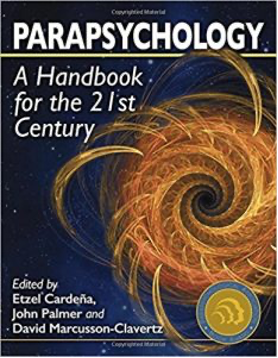
I co-edited an award-winning anthology presenting parapsychology's state of the science, along with its limitations (Cardeña et al., 2015).
David Marcusson-Clavert and I have provided specific supportive evidence that experiencing alterations of consciousness during a psi experiment significantly increases the likelihood of producing results above chance (Cardeña & Marcusson-Clavertz, 2020; Marcusson-Clavertz & Cardeña, 2011), as well as offering a multi-site ganfeld methodology (Marcusson-Clavertz et al., in press).
Selected References (for others see my CV)
Cardeña, E. (2014). A call for an open, informed, study of all aspects of consciousness. Frontiers in Human Neuroscience, doi: 10.3389/fnhum.2014.00017.
Cardeña, E. (2018). The experimental evidence for parapsychological phenomena: A review. American Psychologist, 73, 663-677. doi: 10.1037/amp0000236
Cardeña, E. (2026). Eminent people interested in psi. https://psi-encyclopedia.spr.ac.uk/articles/eminent-people-interested-psi/. Retrieved on August 19, 2026.
Cardeña, E., & Marcusson-Clavertz, D. (2020). Changes in state of consciousness and psi in ganzfeld and hypnosis conditions. Journal of Parapsychology, 84, 66-84. doi:10.30891/jopar2020.01.07
Cardeña, E., Palmer, J., & Marcusson-Clavertz, D. (2015). Parapsychology: A handbook for the 21st century. McFarland.
Holmberg, U. & Cardeña, E. (in press). Replication in small-effect research: Psi research in a broader scientific context. Psychology of Consciousness: Theory, Research, and Practice.
Marcusson-Clavertz, D. & Cardeña, E., (2011). Hypnotizability, alterations in consciousness, and other variables as predictors of performance in a ganzfeld psi task. Journal of Parapsychology, 75, 235-259.
Marcusson-Clavertz, D., Cardeña, E., Wittmann, M., Roe, C., Wahbeh, H., Simmonds-Moore, C, Dechamps, M. C. (in press). Building on the autoganzfeld: An open multisite framework for standardized ganzfeld research. Journal of Anomalous Experience and Cognition.