
DISSOCIATION AND TRAUMA
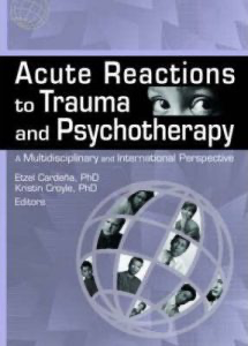
Dissociation is a topic closely related to hypnosis. Some of my main areas of interest are:
- The clarification of the domain (Cardeña, 1994), processes (Cardeña & Marcusson-Clavertz, 2016) and a definition of pathological forms of dissociation (Cardeña & Carlson, 2011).
- Alongside with David Spiegel, a proposal of a Brief Reactive Dissociative Disorder for the DSM-IV (Spiegel & Cardeña, 1991), with became adopted as Acute Stress Disorder, along with two valid and reliable ways to measure acute posttraumatic reactions (Cardeña et al., 2000; Palmborg et al., 2022; see also below under resources).
- Studies and systematic reviews showing traumatic incidents to be an important factor in dissociative phenomena (e.g., Cardeña & Spiegel, 1993; Dalenberg et al., 2012).
- With Sabina Gušić and others, studies on trauma and dissociation among immigrants (e.g., Gušic et al, 2016), including a new instrument to measure immigration stressors (Cardeña et al., 2025).
- Conceptual and empirical studies on pathological and non-pathological experiences of trance and spirit possession (e.g., Cardeña & Schaffler, 2018; Cardeña et al., 2023).
Selected References (for others see my CV)
Cardeña, E. (1994). The domain of dissociation. In S. J. Lynn & J. W. Rhue (Eds.) Dissociation: Clinical and theoretical perspectives (pp. 15-31). Guilford.
Cardeña, E., Sonne, C., Vindberg, E., Carlsson, J., Cervin, M., Silove, D., Hall, J., Coello, M., Momartin, S., Gušić, S., & Aroche, J., (2025). Development and validation of a new comprehensive screening measure of forced migrants/refugees: The Screening of Refugees Self-Report (ScoRE-SR). Nordic Journal of Psychiatry. Doi: 10.1080/08039488.2025.2475940
Cardeña, E., & Carlson, E. (2011). Acute Stress Disorder revisited. Annual Review of Clinical Psychology, 7, 245-267. doi: 10.1146/annurev-clinpsy-032210-104502
Cardeña, E., Koopman, C., Classen, C., Waelde, L., & Spiegel, D. (2000). Psychometric properties of the Stanford Acute Stress Reaction Questionnaire (SASRQ): A valid and reliable measure of acute stress reactions. Journal of Traumatic Stress, 13, 719-734.
Cardeña, E., & Marcusson-Clavertz, D. (2016). The relation of hypnotizability and dissociation to everyday mentation: An experience sampling study. Psychology of Consciousness: Theory, Research, and Practice, 3, 61-79.
Cardeña, E., & Schaffler, Y. (2018). "He who has spirits must work a lot": A psychoanthropological account of spirit possession in the Dominican Republic. Ethos, 46, 457-476. doi.org/10.1111/etho.12216
Cardeña, E., Schaffler, Y., & Van Duijl, M. (2023). The other in the self: Possession, trance, and related phenomena. In M. J. Dorahy, S. N. Gold, & J. A. O’Neill (Eds.), Dissociation and the dissociative disorders: Past, present, future. 2nd ed. (pp. 421-432). Routledge. doi: 10.4324/9781003057314-31
Cardeña, E., & Spiegel D. (1993) Dissociative reactions to the Bay Area Earthquake. American Journal of Psychiatry, 150, 474-478.
Dalenberg, C. J., Brand, B. L., Gleaves, D. H., Dorahy, M. J., Loewenstein, R. J., Cardeña, E., Carlson, E. B., Frewen, P. A., & Spiegel, D. (2012). Evaluation of the evidence for the trauma and fantasy models of dissociation. Psychological Bulletin, 138, 550-588.
Gušić, S., Cardeña, E., Bengtsson, H., & Søndergaard, H. P. (2016). Adolescents’ dissociative experiences: The moderating role of type of trauma and attachment style. Journal of Child & Adolescent Trauma, 9, 341-351. doi.org/10.1007/s40653-016-0107-y
Palmborg, Å., Lötvall, R., & Cardeña, E. (2022). Acute stress among healthcare workers during the COVID-19 pandemic. European Journal of Trauma and Dissociation, 6(3). https://doi.org/10.1016/j.ejtd.2022.100283
Spiegel, D., & Cardeña, E. (1991). Disintegrated experience: The dissociative disorders revisited. Journal of Abnormal Psychology, 100, 366-378. Doi: 10.1037//0021-843x.100.3.366
Resources
SASRQ-I
The SASRQ-I followed DSM-IV criteria for ASD. Contact me if interested in the following translations: Chinese, German, Hebrew, Italian, Korean, Portuguese, Spanish, and Swedish.
Visit Resource →SASRQ-II
The SASRQ-II follows the DSM-5 criteria. Contact me if interested in the following translations: Hebrew, Spanish, and Swedish, and Dutch forthcoming.
Visit Resource →